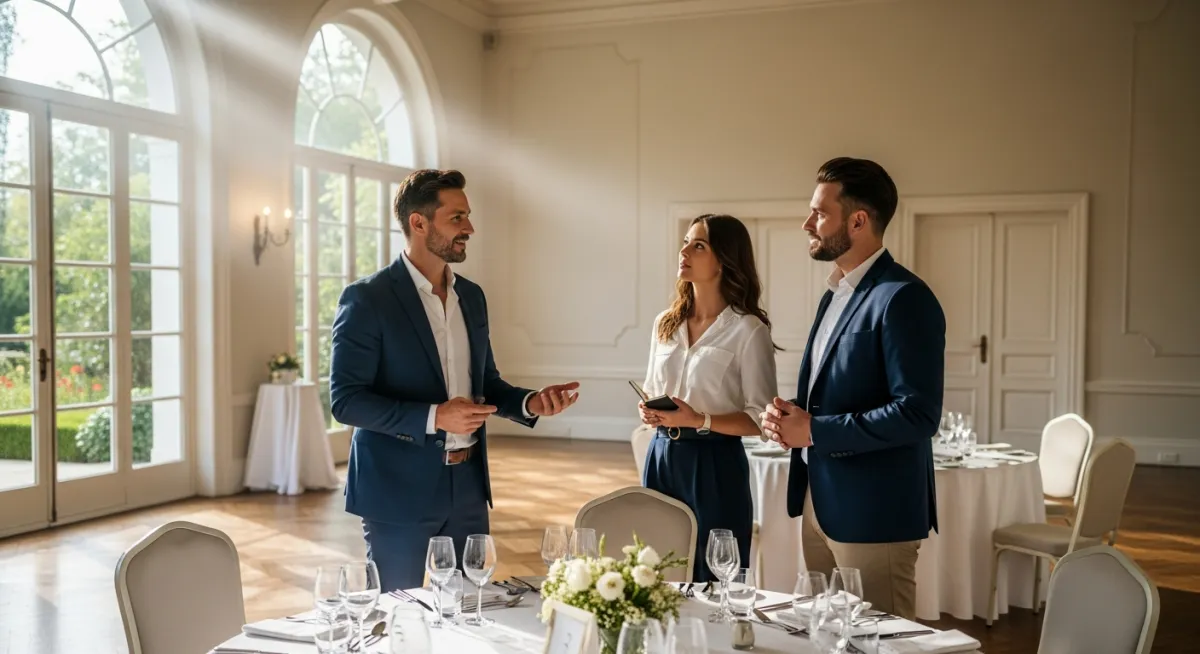
Venue Tour Script That Closes the Booking on the Spot
The Tour Is Where Bookings Are Won or Lost
You can have the best marketing, fastest follow-up, and most beautiful venue in your city — but if the tour falls flat, none of it matters. The venue tour is the single highest-leverage moment in your entire sales process. It is where a couple goes from "interested" to "this is our place."
Think about it from your client's perspective. They have looked at photos online, read your reviews, and confirmed you have their date open. But they are also touring two or three other venues. The decision is not made until they walk through the door. And in those 30 to 45 minutes, they are asking themselves one question: Can I imagine our guests having a great experience here?
Venues that use a structured tour script convert 40 to 60 percent of tours to bookings. Venues with no consistent approach convert 15 to 25 percent. The space, the price, and the market are the same. The conversation is the variable.
The 5-Point Tour Script Framework
This framework gives you the structure to move every tour from showing to booking. Use it in sequence.
- Discovery question at the door. Before walking through the space, ask: "What's the event, and what's the most important thing the space needs to do for you?" Their answer tells you exactly what to emphasize. One couple may care most about outdoor photo backdrops. Another wants strong lighting for photography. A third is focused on parking and vendor setup. If you know this before you start, you walk them through the space with their priorities, not yours.
- Feature — benefit — their specific concern during the walk. Whenever you show a feature, tie it to something they just said. Example: "You mentioned you need room for a live band — this corner is where most of our couples set up their stage, and the outlets on that wall can handle full AV." Never describe a feature without connecting it to something they told you mattered. Facts without context are forgettable.
- Pause at 2 to 3 moments to ask "Does this work for what you described?" Do not save feedback for the end. Check in during the walk. At the ceremony space: "You said you wanted an intimate feel — does this size work for 80 guests?" At the cocktail area: "You mentioned golden-hour photos — this is where we see most photographers set up for that shot." These micro-confirmations build agreement before you ask for the booking.
- Silence objections before asking for the yes. After the tour, ask: "Is there anything you saw that would prevent you from choosing us?" Let them speak. Silence their specific objections first — address parking, pricing, competing dates, vendor policies directly. Only then ask for the booking. Asking for the yes while unvoiced objections sit in the room is the most common reason tours end without a decision.
- Specific date hold offer with a 48-hour deadline. After objections are addressed, say: "The [specific date they mentioned] is currently open. I can hold it for 48 hours with a $500 refundable deposit while you review the contract — would that be useful?" This closes the loop without pressure. You are not forcing a decision. You are offering to protect their date while they decide. The 48-hour window creates appropriate urgency without manufactured scarcity.
The Opening: First 2 Minutes
Do not immediately launch into square footage and capacity when they arrive. Start with the discovery question: "Before we walk through, can I ask — what's the event, and what's the most important thing the space needs to do for you?"
Let them talk for 3 to 5 minutes. Take notes if appropriate. Then tailor everything you show them through the lens of their answer. A formal ballroom setup plays differently for a 150-person black-tie wedding than for a 60-person intimate dinner. Your narration should reflect that difference.
The psychological principle here: people support what they help create. By letting them describe their vision first, they become co-authors of the tour story rather than passive observers of your space.
During the Walk: Paint Pictures, Not Facts
As you move through each area, describe it with their specific event in mind. Do not say "This is the reception hall, it holds 200." Say: "For your 120-guest wedding, picture round tables here with your centerpieces, the dance floor right there, and your DJ set up in that corner with the built-in lighting. Your guests would walk in through those double doors and see the whole room."
Use phrases like "Imagine your guests..." and "This is where your..." to help them see their event rather than an empty room. When you describe the ceremony space, talk about the moment they walk down the aisle. When you show the cocktail area, describe the light at golden hour and how their photographer will use it.
Also, point out specific features they will care about based on what they told you at the door. If they mentioned wanting good lighting for photos, show them the natural light windows and highlight the dimmable fixtures. If they worried about parking, walk them to the lot and show them the capacity. Solve concerns before they ask.
The Soft Close: Creating a Next Step
At the end of the tour, do not say "Let me know if you have questions." That is a dead end. Instead, say: "Based on what you have told me, I think [specific package] would be the best fit. Your date is currently available, but it is one of our popular Saturdays. Would you like me to hold it for 48 hours with a $500 refundable deposit while you decide?"
This does three things at once. It recommends a specific option based on their stated needs. It introduces gentle urgency without fabricating scarcity — popular dates do genuinely fill. And it proposes a concrete next step with a clear, low-commitment ask. People need direction. They need you to point the way.
After the Tour: Follow Up Within 2 Hours
Send a text within two hours: "It was great meeting you today. I'm holding [date] for the next 48 hours as we discussed. Here is a link to the package details: [link]. Let me know if any questions come up."
Two hours is the window. Any longer and they have already moved on to another tour or been distracted. The text should reference what you discussed, include the specific package recommendation, and remind them of the date hold. The post-tour follow-up email takes this further — a structured email within 24 hours that addresses the most common objections before they surface.
Case Study: From 25 to 45 Percent Conversion in 90 Days
An estate venue owner in South Carolina was converting about 25 percent of tours — respectable but leaving money on the table when you consider the cost to generate each tour inquiry. She was giving good tours, but they felt generic. Couples would leave excited, tour another venue, and book somewhere else.
She implemented the pre-tour discovery question sent one week before, rewrote her tour narration to be picture-based rather than fact-based, started recommending specific packages with the 48-hour hold, and committed to two-hour follow-up texts. Within 90 days, her conversion jumped to 45 percent.
Same space. Same price. Same market. The only change was the conversation. Moving from 25 to 45 percent conversion on a venue that sees 20 tours per month means 4 additional bookings per month. At $3,500 average per booking, that is $14,000 in additional monthly revenue — $168,000 annually — from adjusting a single process.
For the complementary piece, see cutting tour no-shows in half — a tour script only produces results when prospects actually show up. Both systems work together.
Frequently Asked Questions
How long should a venue tour take?
30 to 45 minutes is the target. Under 30 minutes signals that you rushed or were not engaged enough to customize the experience. Over 60 minutes is usually a sign that objections were not addressed during the walk and are circling back at the end. A well-structured tour with the 5-point framework moves naturally through discovery, walk, micro-confirmations, objection clearing, and the hold offer in 35 to 40 minutes. If you find tours consistently running long, identify which section is generating the most back-and-forth — that is where an unaddressed concern is living.
Should I let the couple explore on their own or guide every step?
Guide the first pass, then offer a few minutes to explore on their own. Tell them: "Take a few minutes to walk through at your own pace — I'll be right here if anything comes up." Unguided time lets them have a private conversation, which is where the real decision often gets made. Couples who feel rushed through a tour without a private moment report lower satisfaction and lower conversion rates. A 5-minute window after the guided portion costs you nothing and gives them the space to commit internally before you ask for the booking.
What do I do if they ask about price during the tour — is that too early to discuss?
No, it is the right time. If price comes up during the walk, answer it directly without deflecting: "Our Standard package, which would cover everything you have described today, is $3,500. That includes [key inclusions]. I can walk you through a full breakdown after we finish the tour." Do not say "we can talk about that later" — it creates anxiety and makes clients feel like you are hiding something. Answering price directly during the tour removes it as a distraction and lets the rest of the walk focus on value, not number anxiety.
How do I handle the objection "we are looking at two other venues this week"?
Acknowledge it directly: "That makes sense — you should absolutely see a few options." Then add: "What I can tell you is that your date is currently open, and I can hold it while you finish your tours. If after seeing the others this feels like the right fit, the date is still yours. If not, the deposit is fully refundable." This removes the either/or pressure. You are not asking them to cancel other tours. You are asking them to secure their option while they complete due diligence. Clients who feel they can explore without losing their preferred date are far more likely to commit before the week is out.
Have an event venue? List your venue for free on the OMG Rentals Directory and start reaching clients who are actively searching for spaces like yours.
