The Open House That Fills Your Tour Calendar
One Event Can Generate 20 Tour-Ready Leads in One Afternoon
You spend your days scheduling back-to-back tours. Each one takes 45 minutes to an hour. Each one requires you to be present, walking someone through your space, answering the same questions you answered yesterday. Over a month, that is easily 30-40 hours spent on individual tours, with no guarantee that most will convert to bookings.
There is a better way. Instead of the slow trickle of one-on-one tours, host a single open house event that brings 15-30 potential clients through your doors in one afternoon. An open house is dramatically more efficient for you and, paradoxically, less intimidating for leads who are not ready for a formal one-on-one tour. You are not evaluating them while they are there. They are evaluating you alongside other prospective clients in a lower-pressure environment.
Why Open Houses Work
An open house removes several friction points from the traditional tour process. First, prospects do not feel like they are committing to a full sales conversation — they are just coming to an event. Second, you are only present once instead of 20 times. Third, the social aspect works in your favor. When people see other couples excited about your space, they get more excited too. The FOMO effect is real.
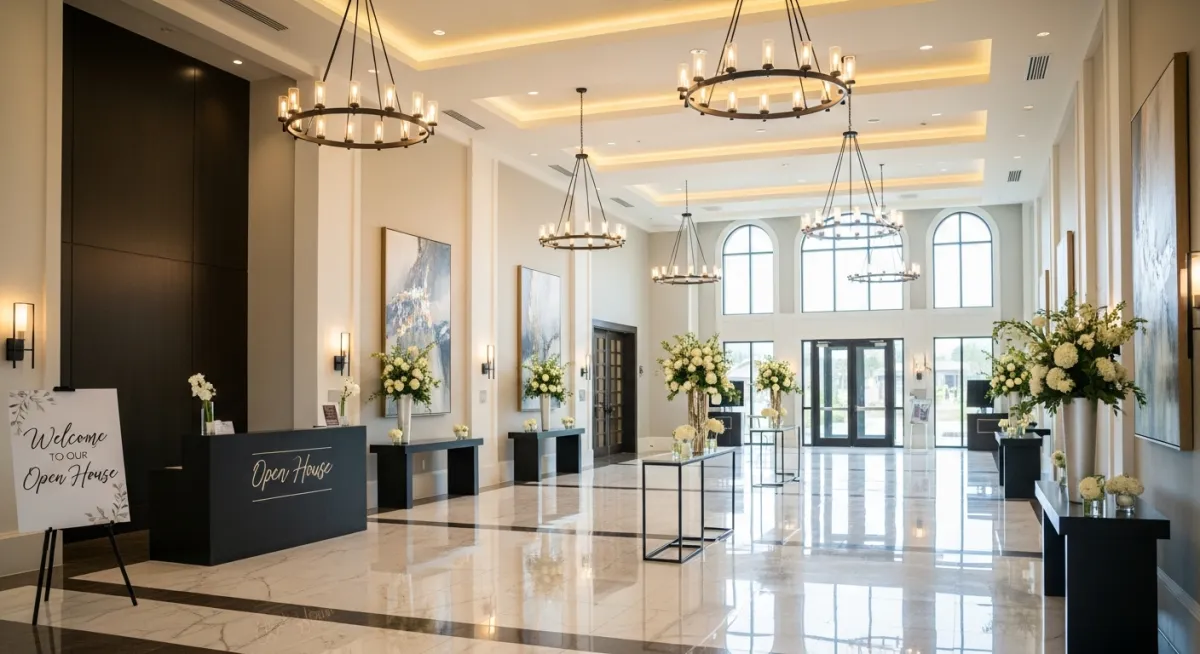
An open house also forces you to stage your venue at its absolute best. Round tables are dressed. Lighting is dialed in. Music is playing softly. Floral arrangements are up. When prospects walk in, they should immediately visualize their event happening in that space. This single staging session creates a backdrop that works for dozens of tours all at once.
How to Plan Your Open House
Step 1: Pick a date 3-4 weeks out. Saturday or Sunday afternoon, 1-4 PM. This timing gives you 3-4 weeks to promote (essential for pulling a good crowd) and gives busy people a weekend option. If you are targeting corporate clients, consider a weeknight option instead — 5-7 PM on a Thursday.
Step 2: Stage the venue as it would look for a real event. This is not a walk-through in an empty room. Set up round tables with linens and centerpieces. Turn on your ambient lighting. Have a playlist playing softly in the background. Floral arrangements or greenery should be visible. If you have a ceremony space, set it up as if a wedding is happening. Walk into your venue pretending you are a prospect. If you would not feel excited seeing it this way, stage more.
Step 3: Invite 3-5 local vendors to participate. Ask a photographer, caterer, florist, and DJ to set up small displays or booths. Vendors get value because they can meet prospects and network. You get value because vendors bring their own clients and promote the event through their channels — expanding your reach at no additional cost. This also strengthens vendor relationships and signals to prospects that you work with quality professionals.
Step 4: Promote aggressively for 3 weeks. Post on Instagram and Facebook three times per week — show behind-the-scenes setup photos, highlight vendors, answer questions about what to expect. Run a targeted Facebook or Instagram ad for $50-100 reaching "recently engaged" people in your area. Email everyone on your contact list. Create an RSVP form in Go High Level or Eventbrite so you have a count. Ask your vendor partners to share the event with their lists. Every dollar you spend on promotion now comes back in qualified leads.
Step 5: At the event, collect information smartly. Set up a digital check-in using a QR code that links to a Go High Level form (or Google Form). The form should capture name, email, phone, event type, and date range. Offer a door prize — a $100 discount on rental, or a professional photo session from a vendor partner — to incentivize sign-ups. Have printed brochures available with your pricing and contact information. Do not try to sell hard while people are there. Let them explore, ask questions, visualize their event. Your job is to make them feel welcome and collect their contact information.
The Follow-Up Is Where the Conversion Happens
This is critical. An open house event does not close deals by itself. It generates warm leads — people who have seen your space and have some level of interest. The follow-up closes deals.
Within 24 hours, text every attendee: "Thanks for coming to our open house. We loved meeting you. Would you like to schedule a private tour to discuss your event in more detail? I have openings this week." Make it easy to respond. The open house creates awareness and emotional connection. The private tour, one-on-one, closes the sale.
You will likely convert 30-50 percent of open house attendees into scheduled tours. You will convert 40-60 percent of those tours into bookings. Math: 25 people at an open house, 10-12 schedule private tours, 4-7 become bookings. A single afternoon event generates 5-7 new contracts.
Example Case Study
An estate venue in Georgia hosted an open house on a Sunday afternoon in October with four vendor partners — a photographer, caterer, DJ, and florist. They promoted for three weeks across Facebook, Instagram, and email. They ran a $150 Facebook ad targeting "recently engaged" in their metro area.
Twenty-two couples attended. Fourteen filled out the check-in form. Within the first week, twelve of those fourteen scheduled private tours. Five of those twelve booked contracts. Total venue revenue from those five bookings: roughly $21,000. Total marketing cost for the open house: $200 in ads and light refreshments. Cost per booking: $40.
Compare that to their average cost-per-booking through other channels, which was around $400-500. The open house model is dramatically more efficient once you run it once and refine the process.
Timing Matters
Do not host your open house during the slowest inquiry season. If you get most inquiries in January for spring weddings, host your open house in December to capture that momentum. If corporate events peak in late spring, host a spring open house. You are trying to catch people actively planning events, not just curious wanderers.
The date you pick does more work than the promotion. For wedding-led venues the strongest windows are January through March, when newly engaged couples start looking, and early autumn, when the following year's calendar opens. Avoid the fortnight either side of a major holiday, and avoid any weekend your own market runs a competing bridal show.
Time of day matters just as much. A late morning to mid-afternoon window on a Sunday lets people come after other weekend commitments and still see the space in daylight, which is what they are there for. Give yourself three to four weeks of promotion ahead of the date: enough time to build attendance, not so much that early registrants forget they signed up.
Scaling This
Once you run one successful open house, consider running them quarterly — one each season. An estate venue or ballroom might do quarterly events. A smaller gallery or loft might do one or two annually. You can also run themed open houses: "bridal showcase" in winter for spring weddings, "corporate event showcase" in summer for fall events. Each open house can target different event types and different crowds.
Frequently Asked Questions
How many people do I need for an open house to be worth it?
Fewer than you would think. A dozen genuinely interested attendees in one afternoon is more tour time than most venues run in a fortnight, and the event costs you one day rather than twelve separate appointments.
Should I invite vendors to co-host?
Yes, for two reasons. They bring their own audiences, which solves your attendance problem, and they make the space feel like a real event rather than an empty room. Agree in advance who follows up with whom so leads do not get worked twice.
Do I need to serve food and drink?
Something, but it does not need to be catered. The point is to give people a reason to linger, because the longer someone stays in the space the more likely they are to picture their event in it. Coffee and something small is enough.
What do I actually do during the event?
Circulate rather than present. Short informal walk-throughs every thirty minutes work better than one speech, and they let you talk to people in small groups where the real questions come out.
When should I follow up with attendees?
The next morning, while the space is still vivid. Reference something specific from the conversation, because a generic thank-you email from an event they attended alongside twenty other people converts poorly.
Ready to turn more inquiries into real bookings? Add or claim your free listing on the OMG Rentals Directory at book.omg-rentals.com so local clients can actually find your venue.